
Simpsonville Resident Lookup Records
Greenville County holds most of the durable records that can help distinguish one Simpsonville name from another. Each record has a narrow purpose. A property card links an assessed owner to a parcel. A recorded instrument documents a transfer or lien. A court docket identifies a party in a proceeding. Marriage, probate, credential, and archive sources can add a date, role, or historical connection. None creates a reliable list of everyone living at an address.
| Record | Fact it can support | Custodian | Access path |
|---|---|---|---|
| Property roll | Assessed owner, situs, mailing field, map number | Greenville County Real Property | Public selected-tax-year search |
| Recorded instrument | Party role, transfer, legal description, recording date | Greenville County Register of Deeds | Current gateway and older index/book route |
| Court or probate case | Party role, case number, case events, estate pathway | County Public Index and Probate Court | Public index, counter, or permitted copy request |
| Marriage record | Named applicants and marriage date | Greenville marriage search | Name and year search, with opt-out option |
| Vital, license, or entity record | Authorized vital fact, credential, or public affiliation | DPH, LLR, or Secretary of State | Eligibility and record-specific rules apply |
Start with the record that fits the question. An old home may call for a parcel and deed comparison. An estate matter starts with Probate Court. A marriage year can narrow two people with the same surname. A license or organization filing can confirm a public role, but a statutory business contact is not a home address. For a former school connection, dated yearbooks and directories in the South Carolina Room are stronger than an unverified current-location claim.
Match Simpsonville Names First
Build a small identity profile before searching. Use the full legal name, an approximate time, a known city or address, a spouse or associate, a business entity, or a property map number. In Real Property Search, enter an owner as Last First. Keep the owner field, situs address, mailing address, and map number separate in your notes. The situs is the property location. A mailing field is where tax correspondence goes. Either can differ from a person’s current location.
Then test the spelling against one independent fact. The best local matches are a legal description on a deed, a recording date, a marriage year, a public case number, or a credential number. A similar street and surname are not enough. Trusts, estates, family members, and repeated names can all make a false match look convincing. Preserve the source title, URL, date viewed, search terms, and instrument or case number with each result.
Search Greenville Court Details
The Greenville County Public Index is a party and case search, not an address directory. Begin with the exact legal name if known and add a first name, middle name, suffix, court or case type, and date range only when supported by the person’s known history. The state routing page also allows a Greenville selection. A known civil action number is entered as the full 13 digits without dashes. Search results should be read as proceedings, not as proof that a party currently lives in Simpsonville.
| Public Index control | How it narrows a search |
|---|---|
| Last, first, middle name or Soundex-style name option | Tests exact spelling and known variants. |
| Case number; court, case type, and subtype | Targets a known matter or jurisdiction. |
| Filing date or date range; party type and status | Separates cases by time and party role. |
| Tax-map range; judgment and lis pendens filters | Limits results where the case carries those records details. |
A county result may show the name, party type, case number, filed date, status, disposition date, type or subtype, judgment number, and court. Opening an available case can add metadata, parties, chronological actions, judgments, associated cases, tax-map information, and financials. Common Pleas civil images are more broadly available online than General Sessions criminal-file images. The Clerk can provide permitted copies; older files may need off-site retrieval. Sealed, juvenile, adoption, dismissed-warrant, and other protected material are not public search targets.
Verify a Simpsonville Resident
A resident lookup becomes dependable when each record adds a fact that the prior record could not supply. The sequence below anchors a name to a parcel without confusing a taxpayer, a party, or a former address for a current occupant. Stop when the documents do not share the same spelling and independent identifier.
- Search the county property roll by Last First and record the tax year, map number, owner, situs, mailing field, and legal description.
- Use the exact party name in the Register of Deeds search and compare the recorded date, legal description, book/page, or instrument number with the parcel.
- When a court matter is relevant, use the Public Index for the known case or a carefully limited party search, then compare its case number and party role.
- Use a marriage year, permitted probate filing, or credential number only as a second identity check. Request an official copy from its custodian when that precise document is needed.
- Docket
- A court’s running list of case events and filings. It identifies the proceeding; it does not establish a current address.
- Index and image
- An index helps locate a record by name or number. An image is the document view, which may be unavailable, restricted, or require a custodian copy route.
- Certified copy
- A custodian-issued copy carrying the office’s certification. It is different from a search-screen result or an ordinary printout.
Simpsonville Marriage and Probate
The Greenville marriage-license search accepts bride name, groom name, and license year. Its results show License, applicant names, Date Married, Opt-Out, and Request Copy. A missing internet result can reflect a participant’s opt-out, so it does not prove that no license exists. Marriage information names applicants on a date; it does not show a current home.
Greenville County’s marriage-license search is shown below with its name-and-year approach.
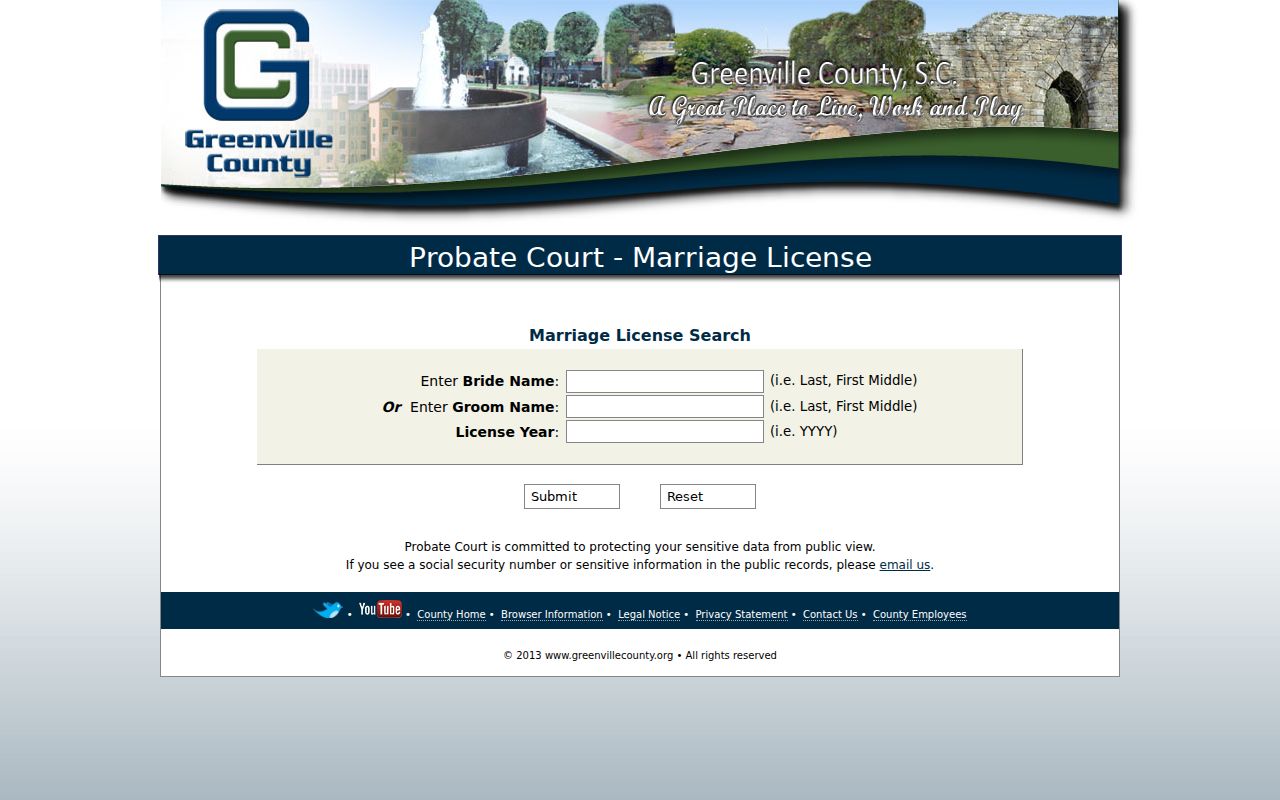
Use the license number and applicant names to request a permitted copy, rather than treating the result row as a full vital record.
For an heir question, begin with the decedent’s name and time frame in Greenville County Probate Court. An estate file may identify a case number and public representative information. If land is involved, compare a permitted probate record with a recorded deed of distribution. An old estate filing does not supply a surviving person’s present address.
Greenville County Probate Court provides the local estates and marriage access route pictured here.
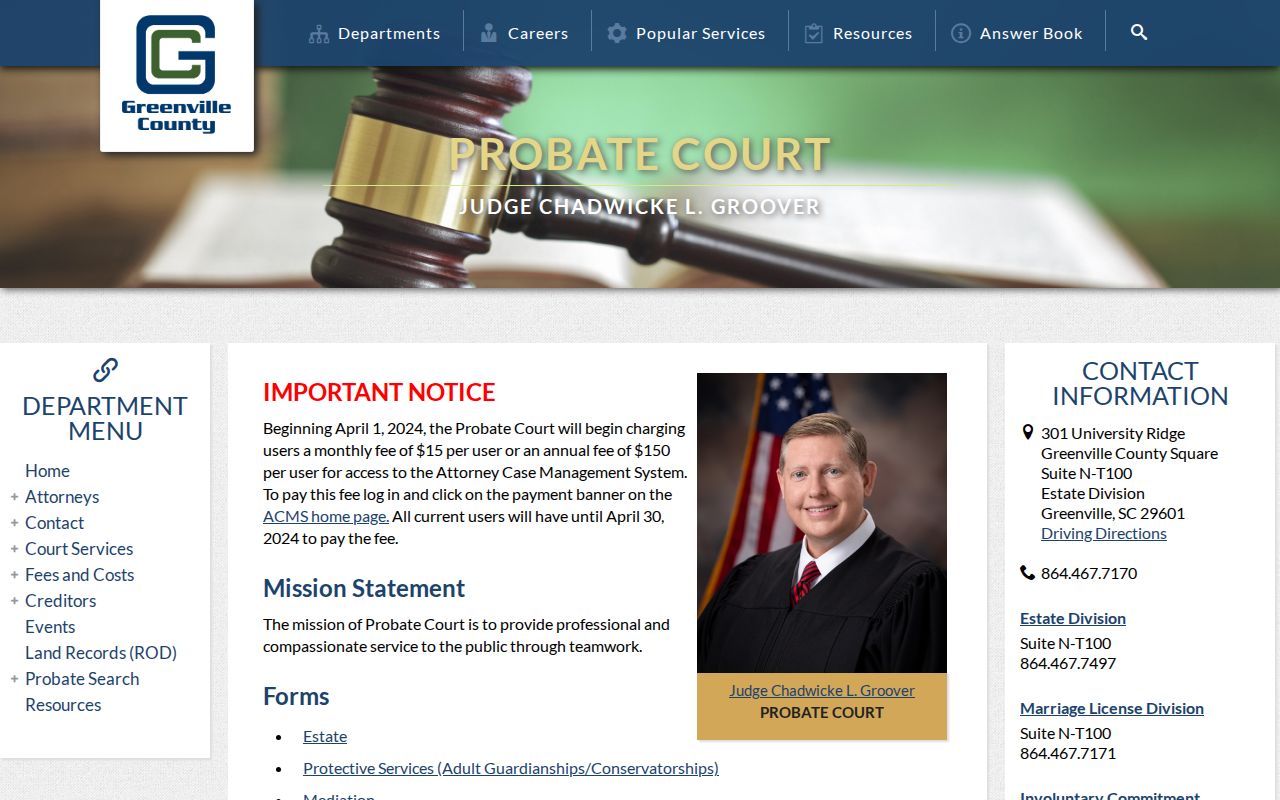
Probate is the right next record for a documented estate path, while the Register of Deeds supplies the separate recorded-land trail.
Use Vital Records Carefully
South Carolina DPH keeps statewide vital-record certification procedures. Birth records become public after 100 years and death records after 50 years. DPH central marriage filing begins July 1, 1950, and divorce reports begin July 1, 1962. A divorce report is not the decree. Request the decree from the Clerk of Court where the final hearing occurred. Current records remain subject to eligibility, identity, and relationship rules.
DPH’s marriage and divorce application asks for applicant contact details and signature, relationship selection, the named spouses or plaintiff and defendant, the event date and county, and the desired record type. The state lists a $12 nonrefundable search, $3 for each additional same-time copy, and a $5 eligible expedited option. Those procedures confirm authorized vital facts, not residential arrangements.
MySCVotes is also personal verification, not a broad name search. It requires County, first name, last name, date of birth, and the last four digits of the Social Security number. A person checking their own registration can use MySCVotes; other voter-data access follows State Election Commission procedures and legal limits.
Reconnect Through Historic Sources
A former-classmate search belongs in the historical record layer. The South Carolina Room has yearbooks, local-history materials, newspapers, microform, maps, and research computers. Start with the school year, the name as printed then, and an address or community clue. Pair a yearbook or directory entry with a contemporary census, newspaper, or property record when distinguishing people with the same name. A yearbook is historical evidence, not proof of a present location.
Adoption records stay confidential. South Carolina’s official Adoption Reunion Registry is a consent-based matching path for adult adoptees and qualifying family members, not a general adoption index. Similarly, a Treasurer unclaimed-property result can be a historical owner or heir lead only after the claimant follows the state’s proof-of-entitlement process. These purpose-built channels protect both identity and privacy.
Note: Record the repository, year, page, spelling, and source identifier for every historical lead before comparing it with a modern county record.
Keep Custody Searches Separate
Custody and criminal-history channels answer narrower questions than a Simpsonville resident lookup. The South Carolina Department of Corrections locator covers people currently sentenced to and housed by SCDC as of the preceding midnight. It excludes releases, county-detention sentences, community supervision, juveniles, and current fugitives. It cannot establish a home address or a complete history.
The state custody locator below shows the separate official channel.
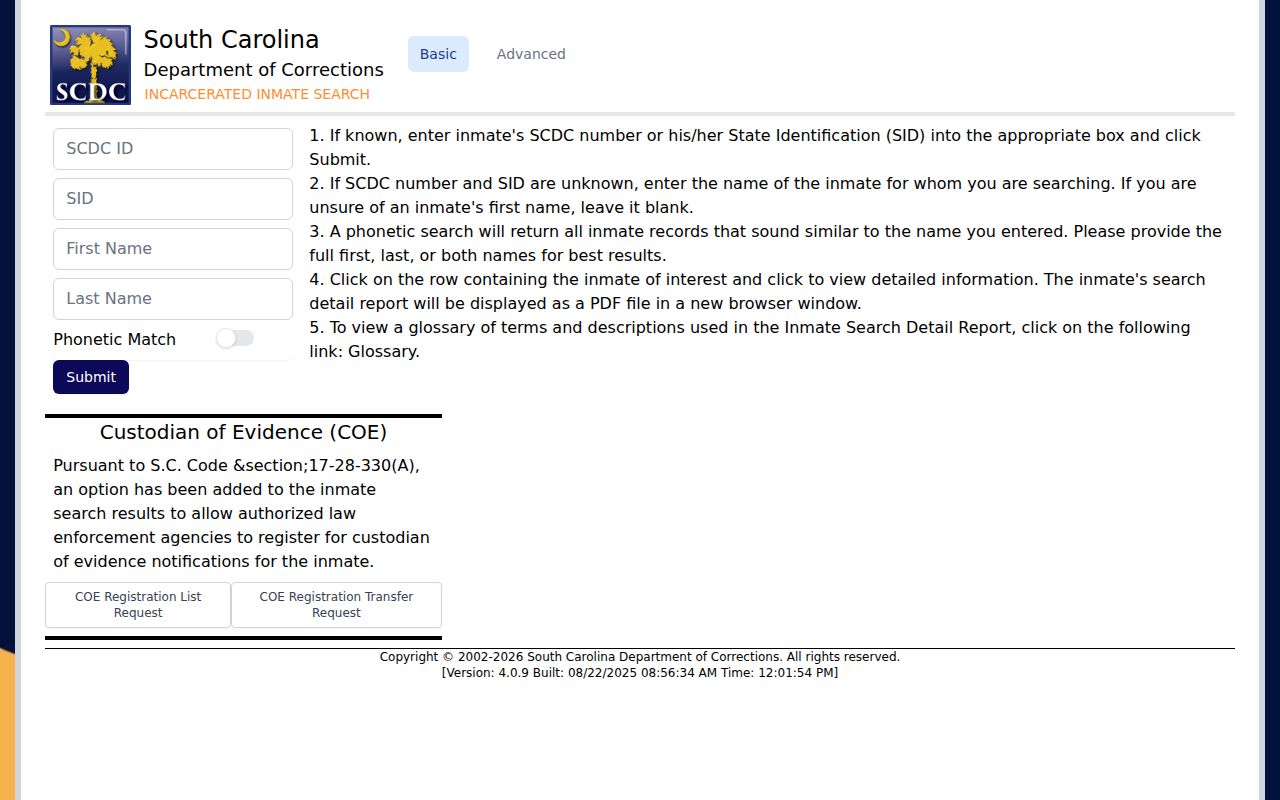
A custody result should be checked against the responsible court or agency, never used to infer where someone lives.
SLED CATCH is a distinct state criminal-record-check route with its own fee and use information.
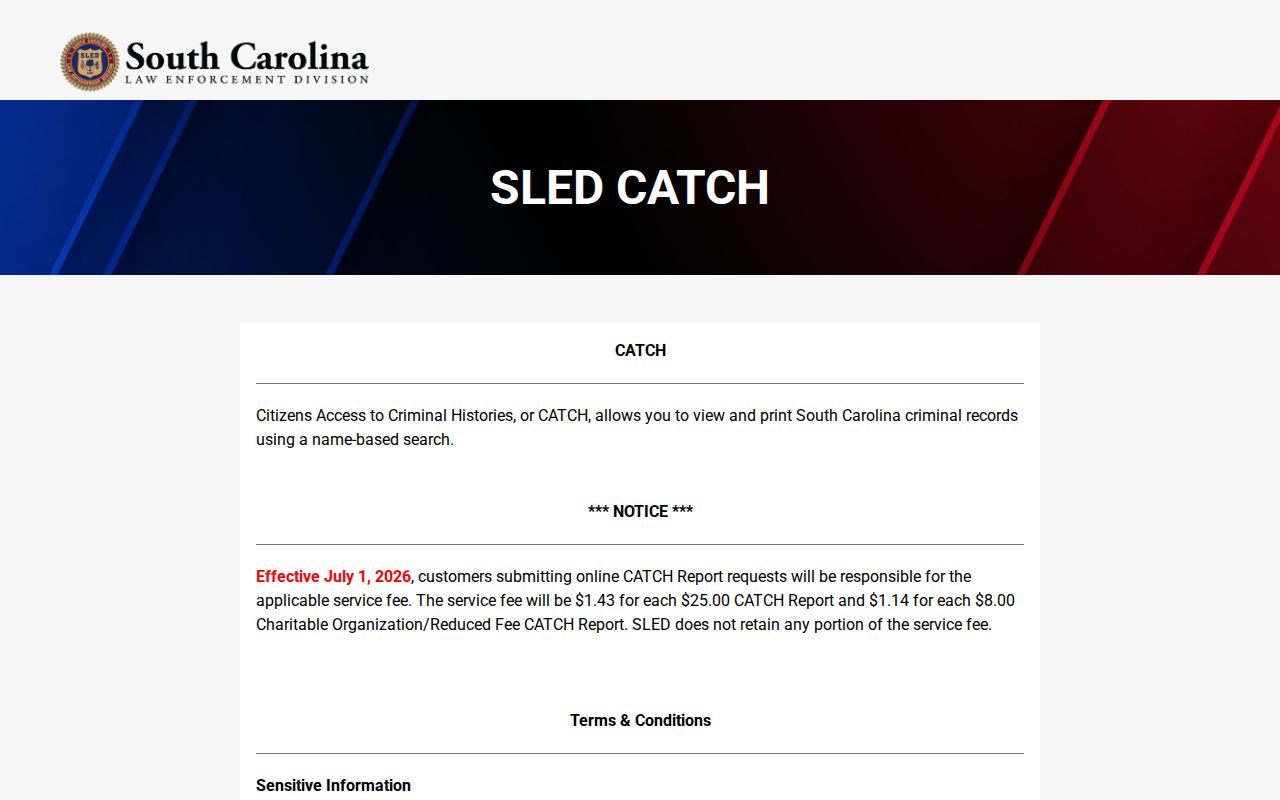
That service is not a substitute for matching a full legal name to a parcel, a recorded instrument, or a court case identifier.
Simpsonville Resident Lookup Limits
Some records must remain private or restricted. Court exclusions include sealed, juvenile, adoption, dismissed-warrant, and other protected matters. DMV information is protected by federal law. DPH eligibility rules govern current vital records. South Carolina’s Address Confidentiality Program gives qualifying participants a substitute address for use with government agencies and courts, and it does not erase prior public records. A substitute or blank address should be left alone.
From January 1, 2026, covered current or former judges and certified law-enforcement officers can use South Carolina’s Judicial and Law Enforcement Personal Privacy Protection Act removal process for certain home-address, personal-cell, and tax-map information on covered public websites. A web field may therefore be blank, old, or unavailable. For a sensitive number displayed in a ROD or Clerk image, a written redaction request can identify the exact page and field.
When Online Searches Stop
A missing online result calls for the relevant custodian, not guesswork. A narrow municipal permit or records question can go through the City’s NextRequest FOIA portal. For an older court file, use the Clerk’s records-copy instructions to ask about counter inspection or off-site retrieval. Pre-1985 land research moves to the ROD grantor/grantee index and book/page route. The County Historical Records portal and South Carolina Room provide the archive path for older material.
Requests under the South Carolina Freedom of Information Act should identify the record type, a defined address or case number, and a focused date range. The City form permits Mail, Pick Up, or Email delivery. A precise request is more likely to reach the correct file while allowing the custodian to apply required redactions.