
Simpsonville City Directory Shelf
Simpsonville's historical directory work is centered at the Greenville County Library System South Carolina Room, not at a separate city register. The catalogued books describe Greenville or Greenville County and sometimes a wider surrounding area. That makes the individual volume decisive. Check the alphabetical section and any demonstrated address section before treating it as Simpsonville coverage. The runs below are documented holdings, not a promise that every year exists or that each book names every Simpsonville household.
| Collection | Years | Where Held | Access |
|---|---|---|---|
| Piedmont Directory Co. | 1909, 1910, 1912, 1913, 1915-16, 1917-18, 1919, 1921-22, 1923, 1926, 1928, 1930 | South Carolina Room, catalog record 16803 | Reference and library use; listed holdings are partial |
| Hill Directory Co. | Selected 1931 through 1974, plus 1977 and 1980 archive copies | South Carolina Room, catalog record 16782 | Reference and library use; no continuous-run claim |
| R. L. Polk, Greenville County | Selected 1983, 1989-93, and 1995, with archive additions | South Carolina Room, catalog record 16809 | Partial run; inspect the volume |
| Polk, Greenville, South Carolina | 1997-98, 2000-01, 2003-25; Simpsonville branch has 2025 volumes 1-2 | South Carolina Room, catalog record 44191 and Simpsonville branch | Recent sets may be multivolume |
Directories from 1883 are reported among local historical holdings, but the inspected sources do not establish an unbroken Simpsonville series. Ask for a particular year and address. That is more reliable than assuming a volume carries every nearby community.
The Piedmont catalog record identifies the early holdings used for a Simpsonville city directory search.
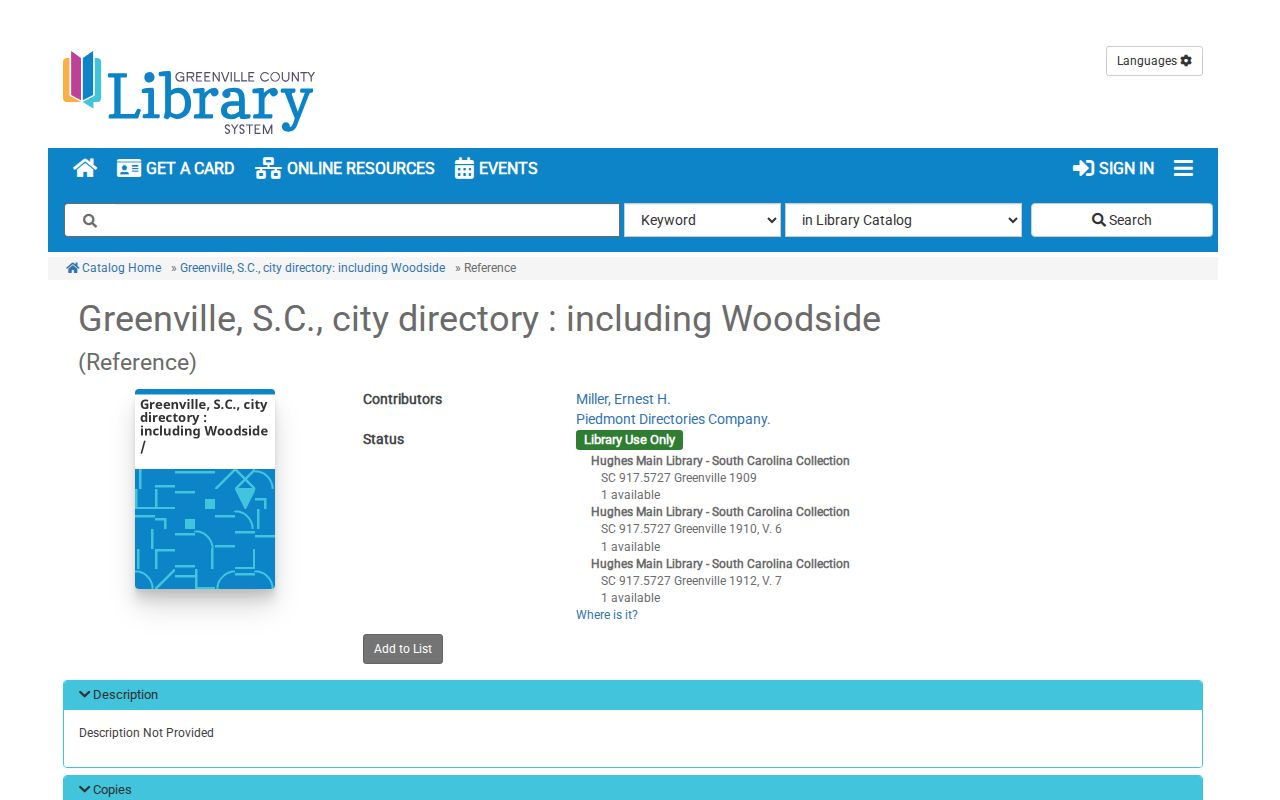
Its listed dates show why adjacent-volume checking matters when a family first appears or disappears.
Simpsonville City Directory Desk
The South Carolina Room is on the second level of Hughes Main Library, 25 Heritage Green Place, Greenville, South Carolina 29601. The library recommends an appointment; the room can be reached at 864-527-9212 or scroominfo@greenvillelibrary.org. Its family files, manuscripts, maps, microform, newspapers, photographs, reference books, research computers, and scanners support the work around a printed listing. A microfilm reader/scanner and book scanner also make it practical to preserve an exact entry and its abbreviation key.
City directories are shelved under call number SC 917.5727. In-library access to Ancestry Library Edition and HeritageQuest supplies another documented directory channel. Ask staff for the book year, a photographed page, and the key from that same volume. For research that cannot be done in person, the room's request service accepts bounded questions with a name, date, and detail; its published categories include newspaper, deed, probate, marriage, death-certificate, and obituary work.
The library genealogy resources show the companion databases available through the Greenville County Library System.
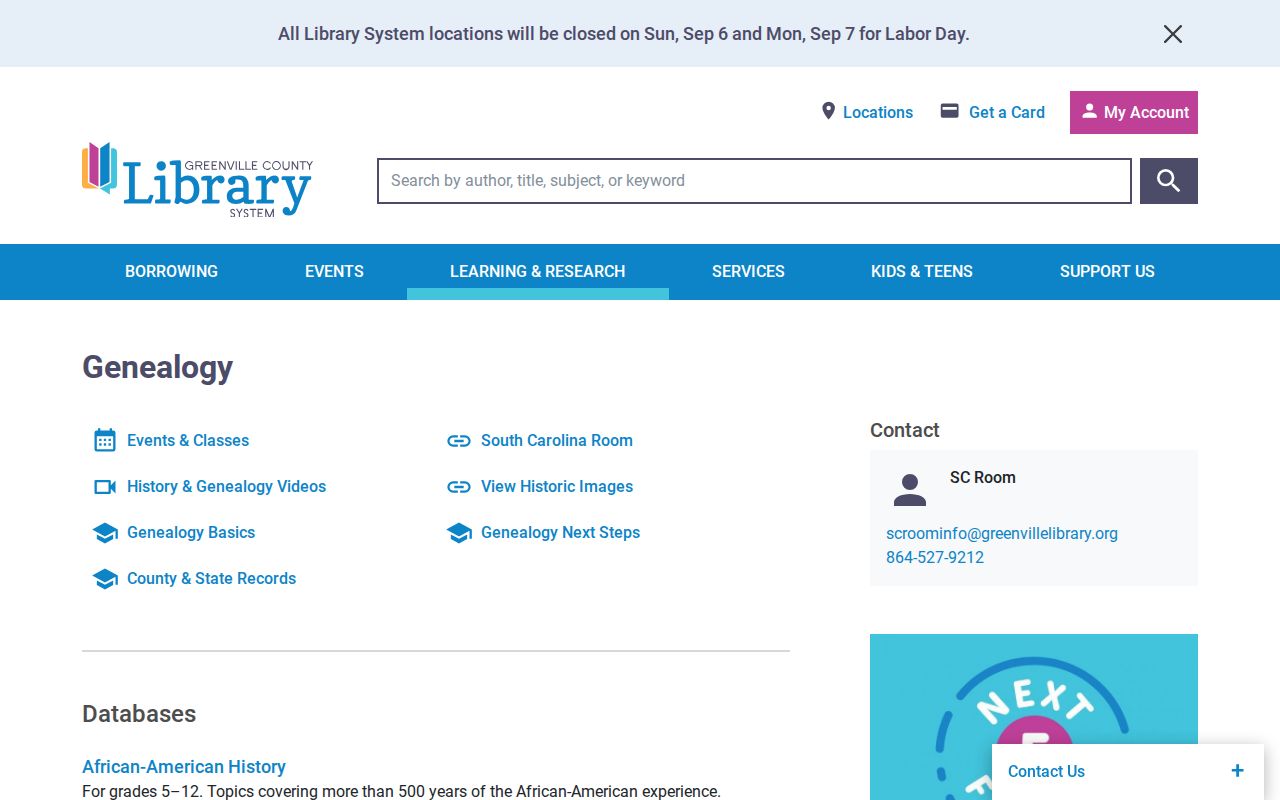
Those databases extend a directory lead, but they do not turn a printed listing into a current identity record.
Note: An appointment, the call number, and a precise year make a South Carolina Room request easier to direct.
Simpsonville City Directory Digital Copies
Digitized material is useful when it supplies a stable item or page reference. The Greenville County Library System's ContentDM service showed 148 digital collections during research, assembled from the South Carolina Room, local organizations, and private contributors. A digitized photograph or document needs its collection and item identifier recorded with it. The digitized 1921 directory is especially valuable because its period abbreviations and entry arrangement can be inspected rather than guessed.
The Greenville digital collections provide the library's searchable historical-material channel.
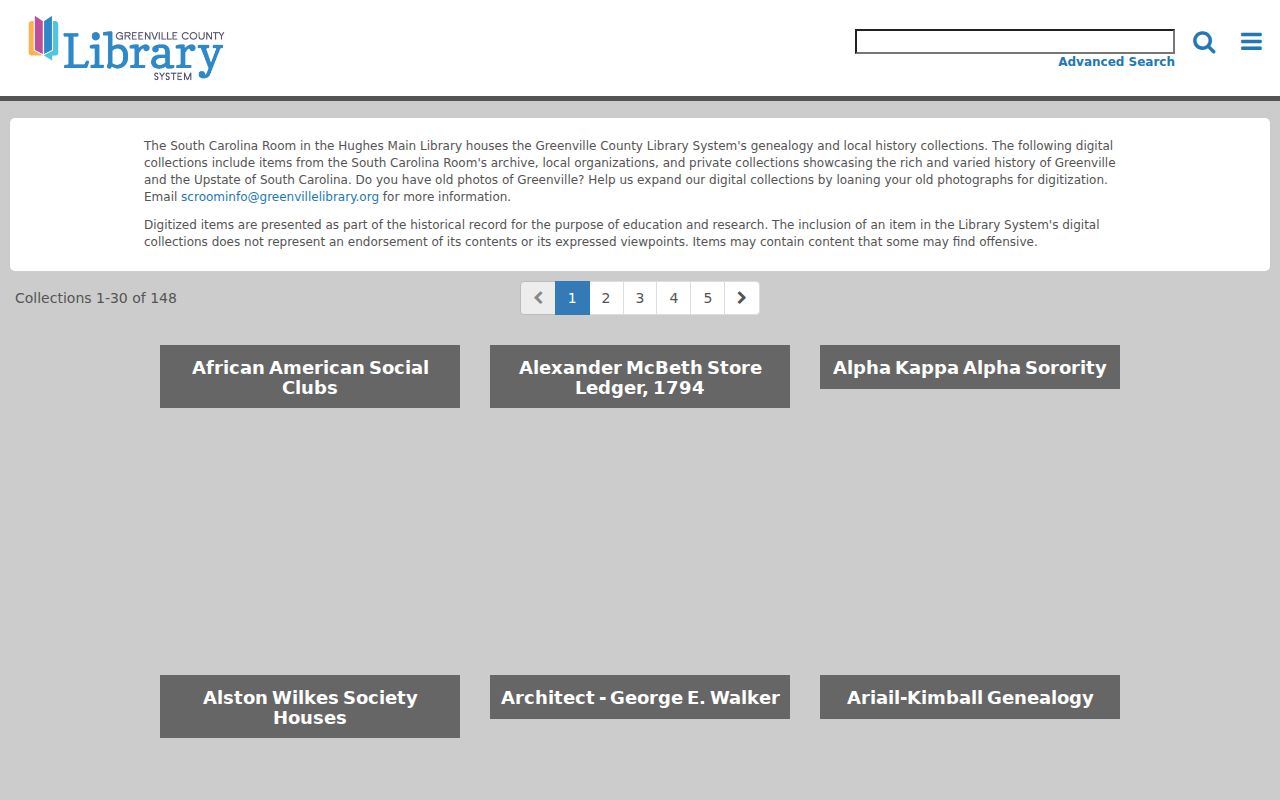
Digital collection results are historical leads, so preserve the item reference before connecting one to a household or address.
The Hill directory catalog record documents the later selected holdings.
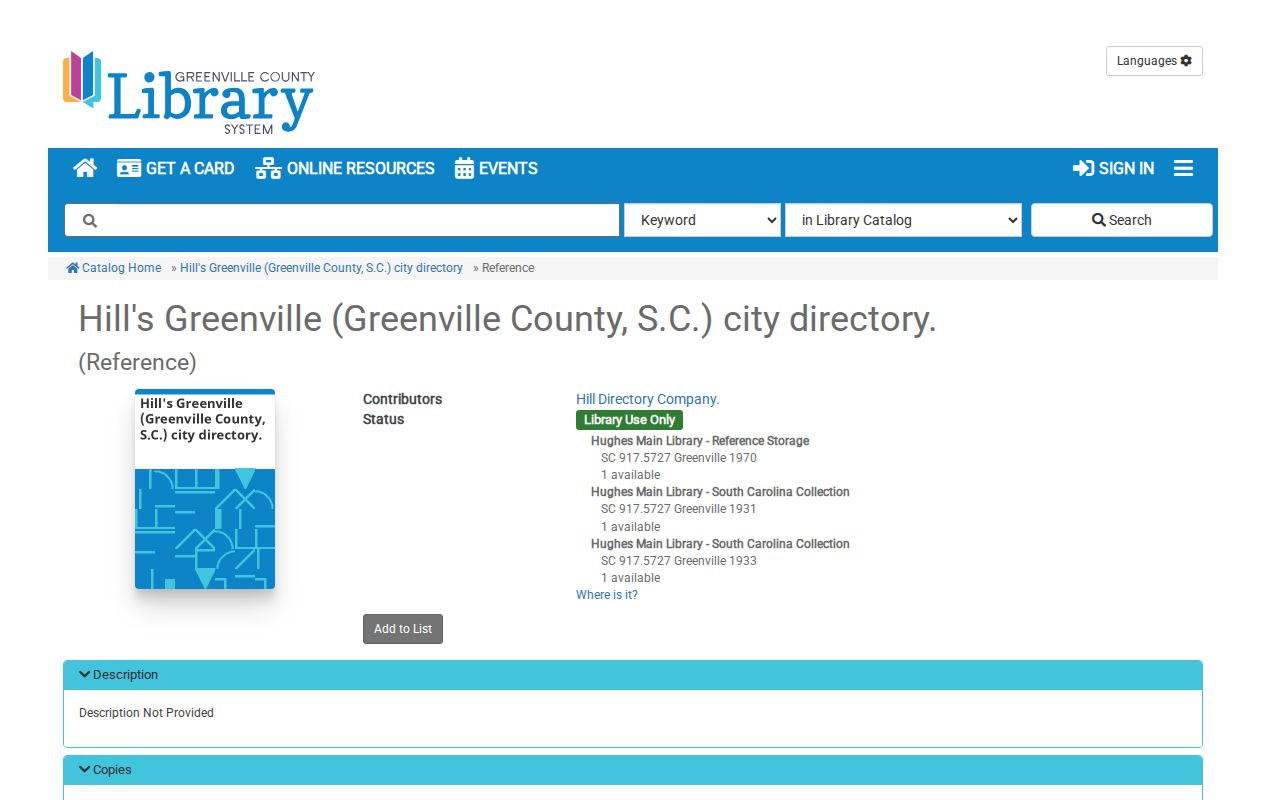
Its gaps are a reason to compare the years that exist instead of filling a gap with an assumed move.
Read a Simpsonville City Directory Entry
An entry in a historical book is a period compilation. The digitized Greenville City & Suburban Directory, Volume XII of the Piedmont Series, offers a concrete 1921-22 example. Its inspected leaf can show a surname and given name or initials, sometimes a business name, household notation in parentheses, and period labels such as wid or Miss. It can also give an occupation, employer or office connection, and a residence marked h. The mark bds signals boarding. Advertisements interleaved with the listings are not person entries.
| Entry element | What the 1921-22 leaf can show |
|---|---|
| Person or business | Surname with given name or initials, sometimes a business name |
| Household notation | A spouse or relationship in parentheses; wid and Miss appear in period style |
| Work detail | Occupation, employer, business, office address, or occasional telephone |
| Residence | h marks a residence; bds marks boarding; a locality or mill qualifier may appear |
| Non-entry material | Advertisements can sit between listings and should not be transcribed as people |
- Criss-cross directory
- An address-ordered section that can place occupants beside streets when that specific volume actually includes one.
- Householder index
- An index organized around the named household rather than every person who may have been present.
- Abbreviation key
- The publisher's explanation of its shorthand, usually found within the same book and essential to reading h, bds, and similar marks.
Record the exact printed name, address, relationship notation, work detail, page or column, full title, publisher, year, and the book's own key. A similar entry format should never be projected onto a different publisher or year.
Note: A period abbreviation has meaning only when read against the key printed in that exact volume.
Simpsonville Directory Clues in 1921-22
The 1921-22 Piedmont volume is a useful local records story because the actual leaf can be checked online. Metadata describes it as a public-domain directory for Greenville and the surrounding area, with provenance from Furman University Libraries and the Greenville County Library System South Carolina Room. That supports a careful statement about the period's printed conventions, but it does not prove that a particular Simpsonville person appears in the book.
The digitized 1921 directory entry shows the inspected Piedmont source page.
The printed page makes the h and bds conventions, relationship notation, work detail, and advertisements visible in their original context.
| Directory period | Catalogued local holding context |
|---|---|
| 1909-1930 | Catalogued Piedmont holdings include selected years, with 1921-22 digitized. |
| 1931-1980 | Selected Hill holdings and later archive copies create an uneven bridge. |
| 1983-1995 | Selected R. L. Polk holdings are documented, with gaps. |
| 1997-2025 | Later Polk holdings are catalogued in selected years, with 2025 volumes at the Simpsonville branch. |
Simpsonville Directory Polk Holdings
Polk titles create two catalogued groupings. The earlier Greenville County title has selected South Carolina Room holdings for 1983, 1989-93, and 1995, while an archive adds several nearby years. The later Greenville, South Carolina title begins in 1997, with selected holdings for 1997-98, 2000-01, and 2003-25. The catalog says recent sets may have more than one volume and includes Greenville and Pickens counties with a neighborhood demographic summary.
The later Polk catalog record is the best starting point for a documented recent directory volume.
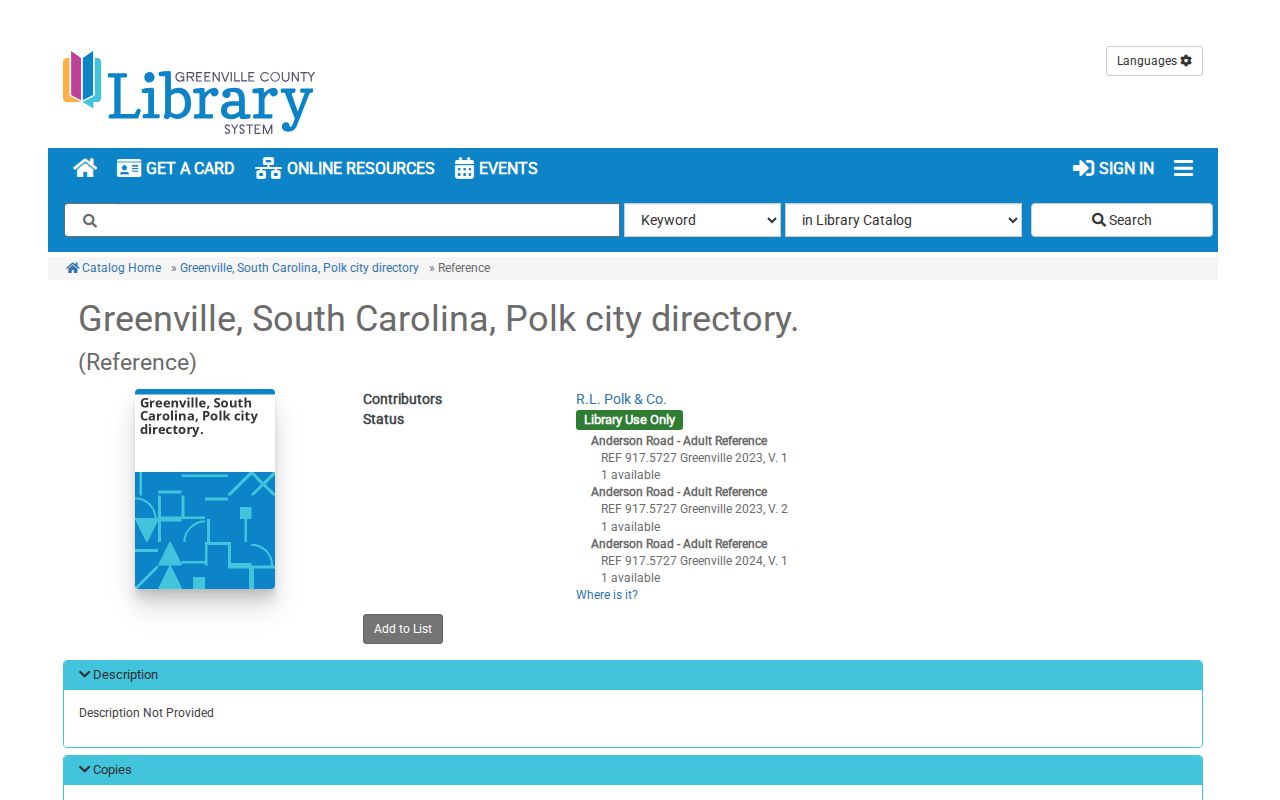
Inspect the selected volume before describing its sections or deciding that a Simpsonville address was included.
Simpsonville Maps Beside Directories
A printed address needs geographic context. The South Carolina Room's house-history materials identify the Greenville City Block Book for 1923-24, held on microfiche, and land maps such as the 1882 Kyzer and 1825 Mills Greenville County maps. The Library of Congress catalogue identifies a four-sheet Simpsonville Sanborn Fire Insurance Map dated June 1930. It is catalogued, not digitized. Request it through the holding or research channel rather than expecting a free map image.
City limits changed over time. A Greenville block book provides urban block context, not proof of Simpsonville coverage, so compare the relevant plat, legal description, map year, and directory entry before drawing an address conclusion.
Note: A map can reconcile place names and streets, but it does not identify a household by itself.
Trace Simpsonville City Directories
For a household trail, begin with a volume that actually covers the name or address, then move in sequence through the nearest available years. A disappearance can mean a move, death, marriage-name change, omission, changed coverage, or a different address. It does not establish one explanation by itself. Pair a directory year before or after a federal census release with that census's enumeration district and the known property or deed dates.
- Find the first confirmed alphabetical entry and record the full title, year, page, address, and abbreviation key.
- Check adjacent available years, keeping spelling variants, initials, household notation, and work details in the same research note.
- Use an address or criss-cross section only after confirming it exists in that exact volume, then compare its result with the alphabetical listing.
- Compare the resulting timeline with the property card, deed date, and a released federal census schedule.
- Use a newspaper notice, obituary, probate file, map, or vertical file to test a change, preserving each repository and page reference.
When a historical directory find needs a modern record check, the county sources used for that task are kept separate on the Simpsonville resident lookup page.
Simpsonville Newspaper Followups
Directory evidence becomes stronger when another dated source agrees. The library genealogy portal lists Historic American Newspapers, HeritageHub death notices, America’s Newspapers, FamilySearch, Fold3, and in-library genealogy databases. Historic South Carolina newspaper coverage is stated as 1777-1963, while Greenville News access is stated as 1999-present. That leaves possible middle-period gaps dependent on the database or microfilm holdings.
Search surname variants, initials, married names, and old community names. Retain the publication, date, page, or persistent database link. A notice can supply historical context, but it should be read alongside the directory entry and any accessible official record.
Note: A newspaper gap is a records limitation, not evidence that no notice or household change occurred.
Simpsonville Historical Records Bridge
When a directory points toward land, probate, or court material, Greenville County Historical Records provides a separate digitized route for historical probate, Register of Deeds, court, and related collections. Its documentation says associated microfilm can also be viewed at the South Carolina Room and county custodian offices. The three channels are distinct: an online historical scan, library microfilm and research assistance, or the responsible county office for the record itself.
Early research has another caution. The reconstructed Land Grant Book B index for 1785-87 has missing pages and name variants, and is not itself an official document. Use variant spellings, then confirm a finding against an available record image or the custodian copy.