
Finding Simpsonville Resident Records
Match the search to the question. Greenville County Real Property Search is the practical first stop for a parcel, owner name, street, or map number. A recorded deed can then establish a land transaction. The Greenville County Public Index can confirm a party in a public case, while Probate Court and the marriage search answer narrower family-history questions. Earlier households are usually documented by the Greenville County Library System rather than by a modern address tool. A name match is only a lead until one independent fact supports it.
Use an address, date, legal description, case number, or known relationship to test that lead. The county property card separates the physical parcel from the tax mailing address. Neither field identifies all people at the location. Court and vital sources have their own access rules. A careful Simpsonville residents directory search records the source, the date viewed, the identifier, and exactly what the record proves.
- Start with the name, address, or period that is already known and choose the custodian that records that fact.
- For land, search the property card and save the tax-map number, situs, owner field, and legal description.
- Compare that parcel detail with a recorded instrument, a public case, or a dated historical source before connecting names.
- Move to the South Carolina Room when the question involves an earlier household, old address, map, newspaper, or directory year.
- Ask the office for a narrow existing record when a scan is unavailable, rather than asking staff to identify a household.
Simpsonville Records Custodians
Simpsonville creates city records, but the durable land, court, probate, assessment, and election channels used in resident research are mainly Greenville County or South Carolina systems. The City’s modern public-records portal is useful for a specific municipal permit, planning decision, or meeting record. It is not a citywide inhabitant list. The county offices below keep different record types, so their results should not be treated as interchangeable.
Register of Deeds
301 University Ridge, Suite S-2100
Greenville, SC
864-467-7240
Real Property Services
Greenville County assessment and parcel records
864-467-7300
Registration and Elections
225 S. Pleasantburg Dr., Suite B6
Greenville, SC 29607
864-467-7250
For a street-wide parcel method, use the focused Simpsonville street directory approach instead of treating a county office list as a household roll.
Simpsonville Parcel Name Searches
The Greenville County Real Property Search requires a tax year, then accepts an owner name, street, 13-digit map number, subdivision, or sales-sheet number. The county examples place a surname first for a name search. A result can tie an owner field to a situs address, mailing address, legal description, assessment information, and deed or sales references. Save the map number because it is the handoff to GIS, plats, and deed research.
| Real Property field | How it helps | Important limit |
|---|---|---|
| Select Tax Year | Fixes the assessment year being compared | It is required before searching |
| Enter Name | Tests an owner field in last-name-first form | Owner does not necessarily mean occupant |
| Enter Street | Returns parcel cards along a road | It is not a list of every resident |
| Enter Map No. | Finds a specific parcel with the 13-digit PIN | Use the selected tax year |
| Subdivision or sales sheet | Offers a second way to narrow a property search | Compare the legal description too |
The county property-search screen shows the available search choices.
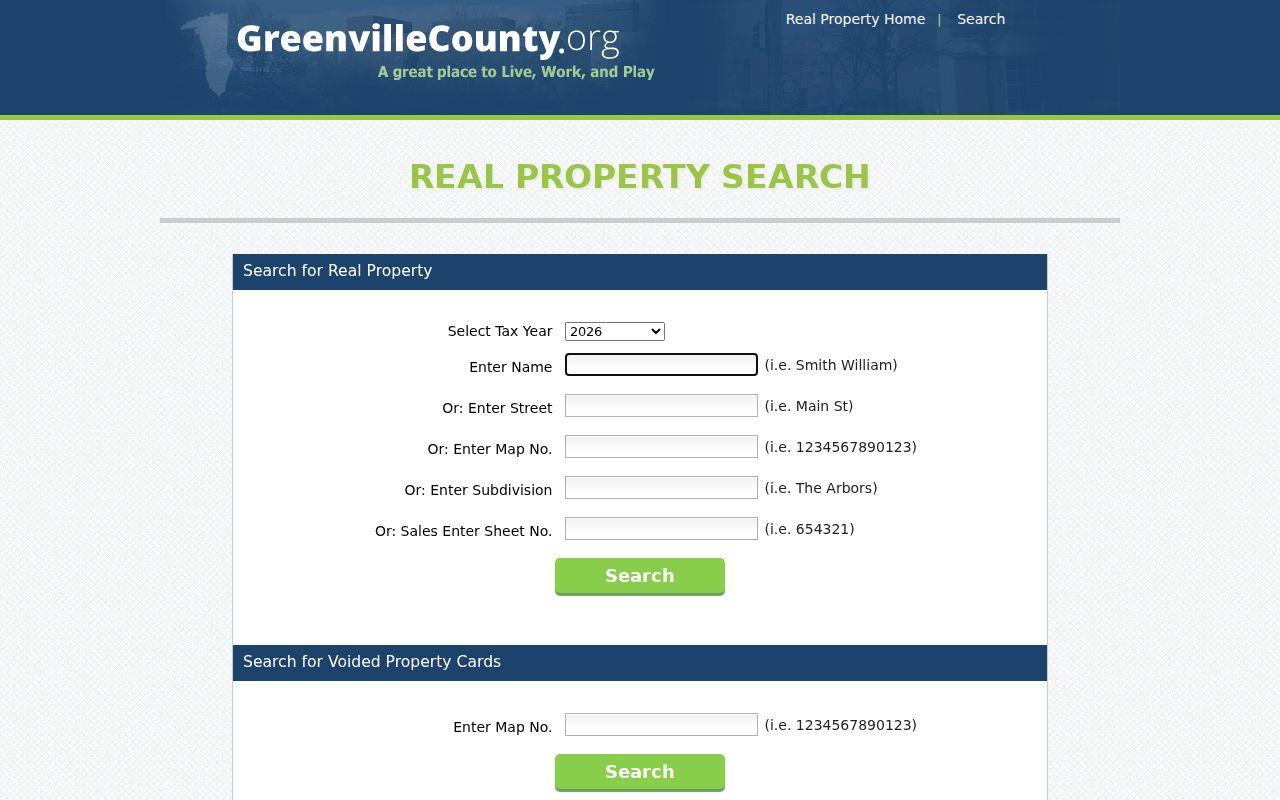
The search screen illustrates why the tax year and one precise key should be noted with every Simpsonville parcel result.
Simpsonville Deed Index Paths
The ROD public records gateway states online coverage from 1985 forward. Search by an indexed name, instrument number, book and page, or legal description, then narrow by document type when needed. A deed records a transfer and a party role. It does not certify that a party lives at the property. Compare the legal description, recording date, book or instrument number, and parcel details before adding it to a Simpsonville resident trail.
Older research takes a different route. The ROD directs pre-1985 work to document folders and grantor or grantee indexes that lead to a book and page. Deed books, microfilm, the ROD counter, and the library are all documented fallback channels. That handoff is a local records story worth preserving: a web cutoff changes the search method, not the beginning of Greenville County land records.
The ROD gateway is the current entry point for the later online path.
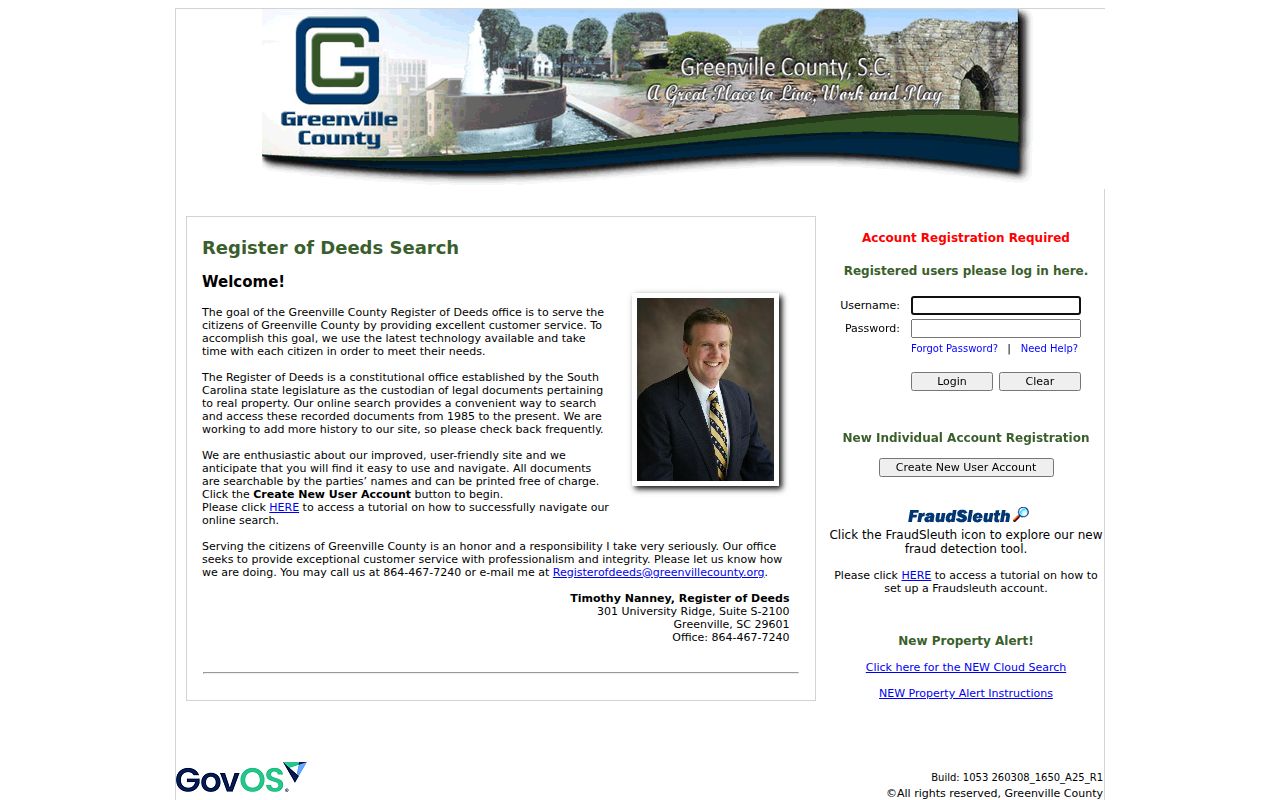
Use its search result as an indexed record trail, then obtain the allowed image or certified copy through the custodian when that distinction matters.
Current Simpsonville Directory Sources
There is no single official directory of everyone in Simpsonville. The closest current sources each describe a limited relationship: ownership, a recorded transaction, a court party, a public civic role, an official credential, or a person’s own voter registration. The right source depends on the fact to be checked. For a detailed one-name process, the Simpsonville resident lookup method keeps those distinctions clear.
| Directory-like source | What it can establish | Custodian | Access route |
|---|---|---|---|
| Property roll | Owner field, parcel, situs, mailing, legal description | Real Property Services | Public web search |
| Recorded instruments | Party to a deed, lien, plat, or other document | Register of Deeds | Online gateway, historic index, counter |
| Public court and probate files | Party role, case or estate trail | Clerk or Probate Court | Index, public access, permitted copies |
| City staff directory | Public city staff contact information | City of Simpsonville | Published city directory |
| Professional or entity records | Credential or public business affiliation | LLR or Secretary of State | Official state lookup |
Commercially compiled people-search products may mix old material and same-named people. They are not a substitute for a cited public record or archive source.
Simpsonville Voter Record Limits
MySCVotes is a personal registration tool, not a public name-by-street browser. Its sign-in requires county, first name, last name, date of birth, and the last four digits of the Social Security number. A person may use it to review their own registration information, ballot and polling details, update status, and personal participation history where available. The form has no captured ZIP, street, radius, export, or public result-grid field.
The State Election Commission has a separate voter-list product process with statutory limits, including South Carolina’s commercial-solicitation restriction. Ask the Commission directly about lawful scope and available geography. Do not attempt to build a Simpsonville household list from individual voter records.
The MySCVotes form displays the identity-verification fields before access.
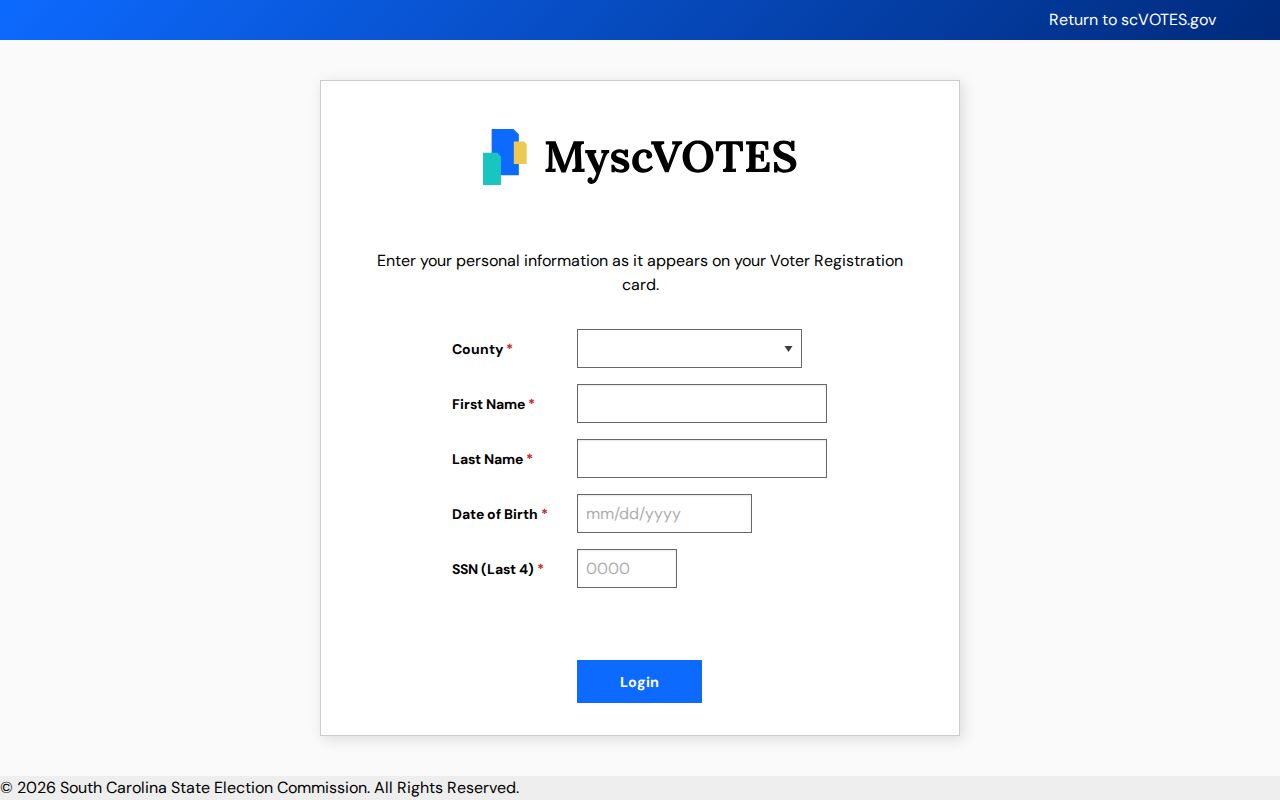
That login design is a practical limit on resident searching, not an invitation to supply another person’s identifying data.
Simpsonville Court and Vital Trails
The Greenville County Public Index can confirm that a named party appears in a public trial-court case. A docket is a case record, not address confirmation. Greenville Probate Court holds estate material and local marriage resources; its marriage search uses bride name, groom name, and license year, and online listing can be suppressed by participant opt-out.
South Carolina Department of Public Health handles statewide certifications. Birth records become public after 100 years and death records after 50 years. DPH centrally filed marriage records begin July 1, 1950, and divorce reports begin July 1, 1962, while the actual divorce decree comes from the Clerk of Court. Eligibility rules and the request form govern a certified copy. These sources can support family history or an estate trail, but they should never be treated as a current-address directory.
The county Public Index is the official trial-court search entrance.
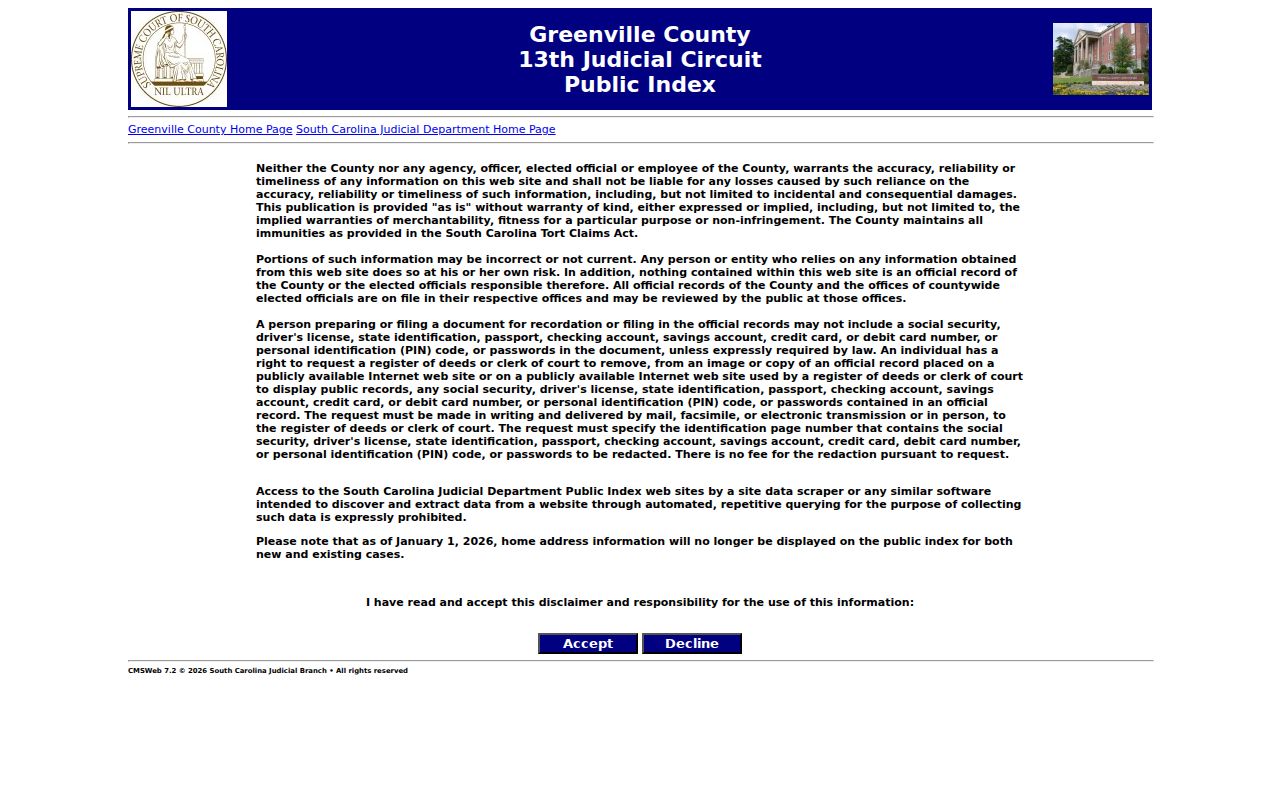
Use a full case number, party role, and dates to distinguish similar names before requesting a permitted court record.
Simpsonville Municipal Record Requests
When a defined municipal record is not online, use the City of Simpsonville’s public-records request portal or its written form. The city describes messages with staff, request tracking, uploaded responses, and access to formerly published material. A useful request names the address, record type, narrow date range, permit, case, or meeting. The form allows mail, pickup, or email delivery.
South Carolina FOIA, S.C. Code Ann. tit. 30, ch. 4, sets the response framework for identifiable records. The city form states a determination in 10 business days for records less than 24 months old and 20 business days for older material, followed by the applicable production schedule after any deposit. The City’s 2026 fee schedule describes possible deposits, labor, and copying charges. Those rules do not require staff to create a resident list or release an exempt record.
Simpsonville’s portal provides the official municipal request route.
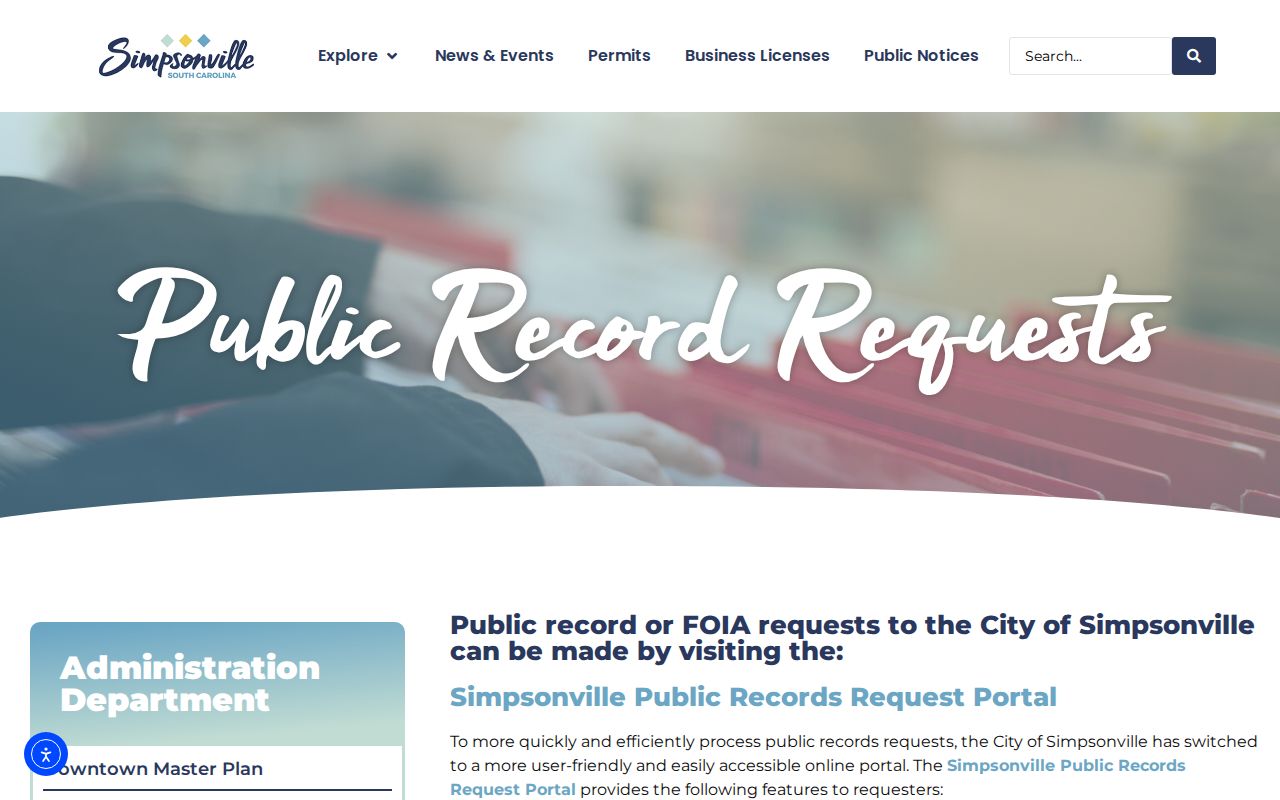
Use the tracking and message features to follow one specific records request, rather than sending a broad person-search request.
Simpsonville Address Geography
Simpsonville is served by both 29680 and 29681. City fire-station, council, planning, and other official addresses show both labels. That fact matters when a record search begins with only a mailing locality. A postal ZIP does not decide municipal limits, election precinct, permit jurisdiction, parcel boundary, or resident identity. Confirm a full delivery address through USPS, then use the county map number and property card for land research.
The official USPS ZIP Code Lookup supports ZIP-by-address and ZIPs-by-city/state searches, but warns that a ZIP result does not confirm a person or organization at an address. The two labels are a records-geography reminder: choose the city for a municipal record, Greenville County for a property record, and USPS for mailing format.
DPH’s vital-records information is one statewide example of a custodian whose coverage is not determined by a Simpsonville ZIP.
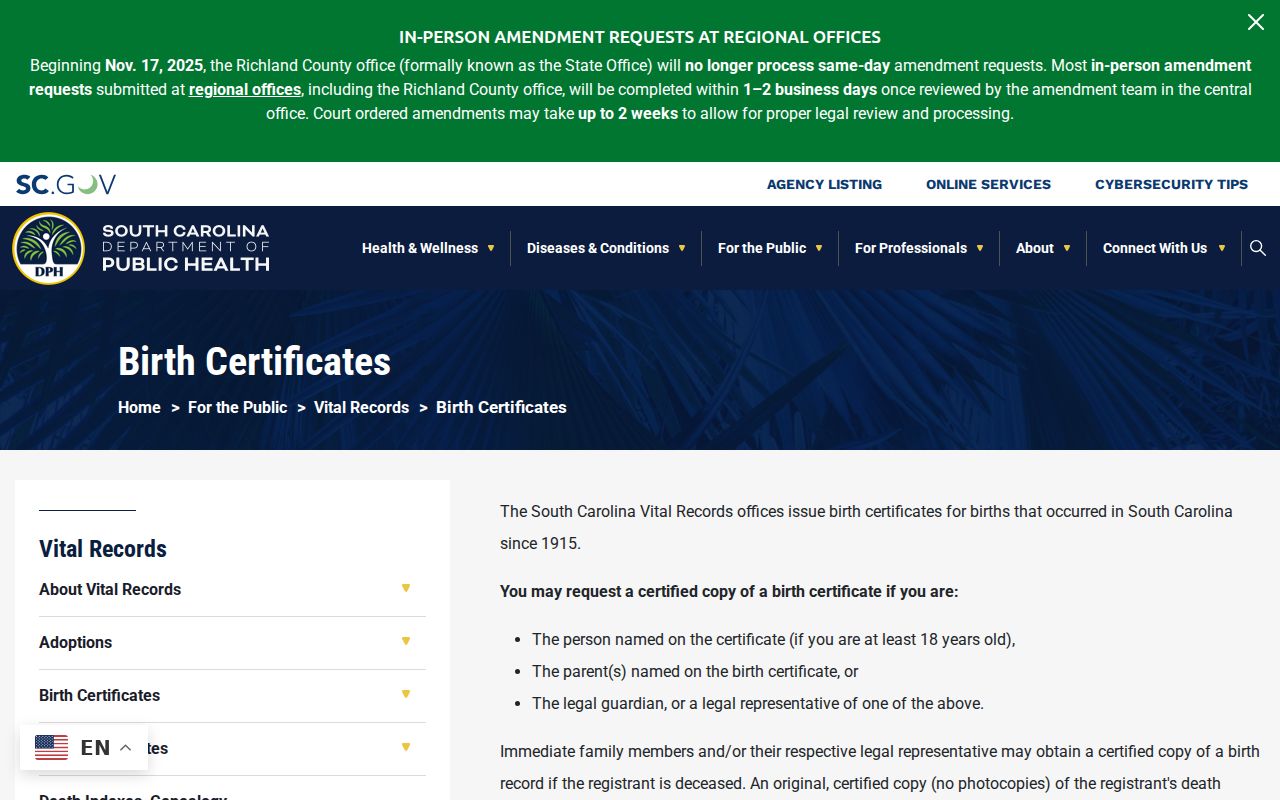
Statewide record access rules apply even when the event or family connection is rooted in Simpsonville.
Simpsonville Directory Terms
Several ordinary-looking words carry different meanings in public records. Reading those labels correctly prevents a loose name match from becoming an unsupported claim.
- Parcel
- A defined piece of land tracked by a county map or tax identifier.
- Roll
- A record set maintained for a particular purpose, such as assessment or registration, not a universal population list.
- Index
- A finding tool that points to a document, book, page, case, or record number.
- Criss-cross directory
- An address-oriented directory section, when a particular historical volume actually includes one.
Keep the underlying record and its date with any conclusion. An index entry is a lead, while an image or certified copy may carry more detail and separate access rules.
Simpsonville Historical Directory Shelves
The Greenville County Library System’s South Carolina Room at Hughes Main Library is the core historical channel for Simpsonville. It holds city directories, maps, microform, newspapers, family files, photographs, research computers, and scanners. The library catalog lists Piedmont volumes from the early twentieth century, selected Hill’s volumes through the mid-century period, and Polk runs into recent decades. Each is a Greenville-area source, so a Simpsonville person or address must be checked in the actual volume.
The 1921–22 Piedmont directory is digitized and shows period conventions such as h for residence and bds for boarding. A historical entry can include a name, relationship notation, work or business detail, address, and occasional telephone or office detail. It speaks for its own publication year. The fuller collection and reading method belong in the Simpsonville city directory reference.
The South Carolina Room identifies its local-history services and appointment guidance.
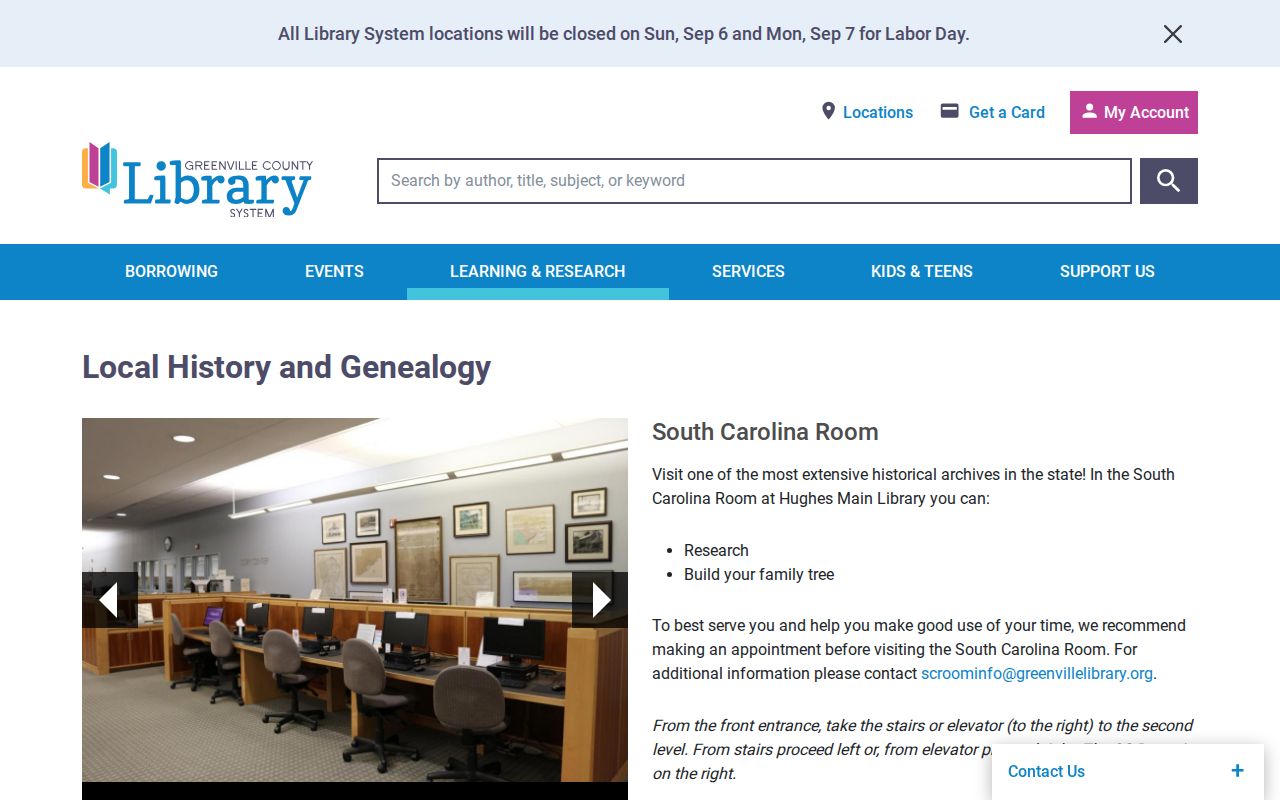
Its microfilm and scanning equipment give a researcher a way to preserve the volume, page, and abbreviation key behind a historical entry.
Simpsonville State Record Checks
State sources can confirm a different kind of public relationship. South Carolina Business Entities Online is for organizations and registered-agent records. The LLR Licensee Lookup checks regulated credentials. A business or license address may be a statutory or professional contact, not a home address. Save the entity name, filing number, board, status, or document date rather than inferring more.
The state business search offers entity, agent, filing, document, and certificate paths.
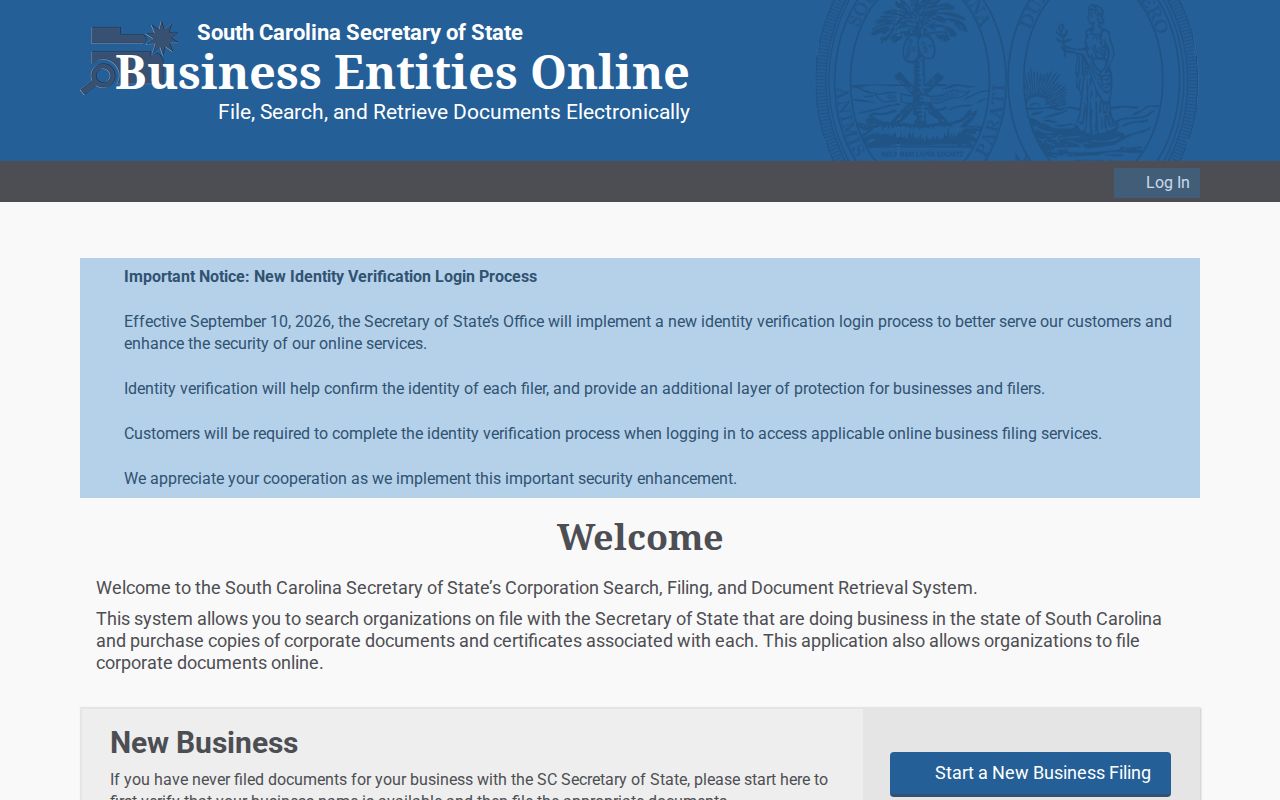
That official result can corroborate a public affiliation, but it does not turn an organization record into a resident listing.
The LLR licensee lookup is another official state check with board-specific public data.
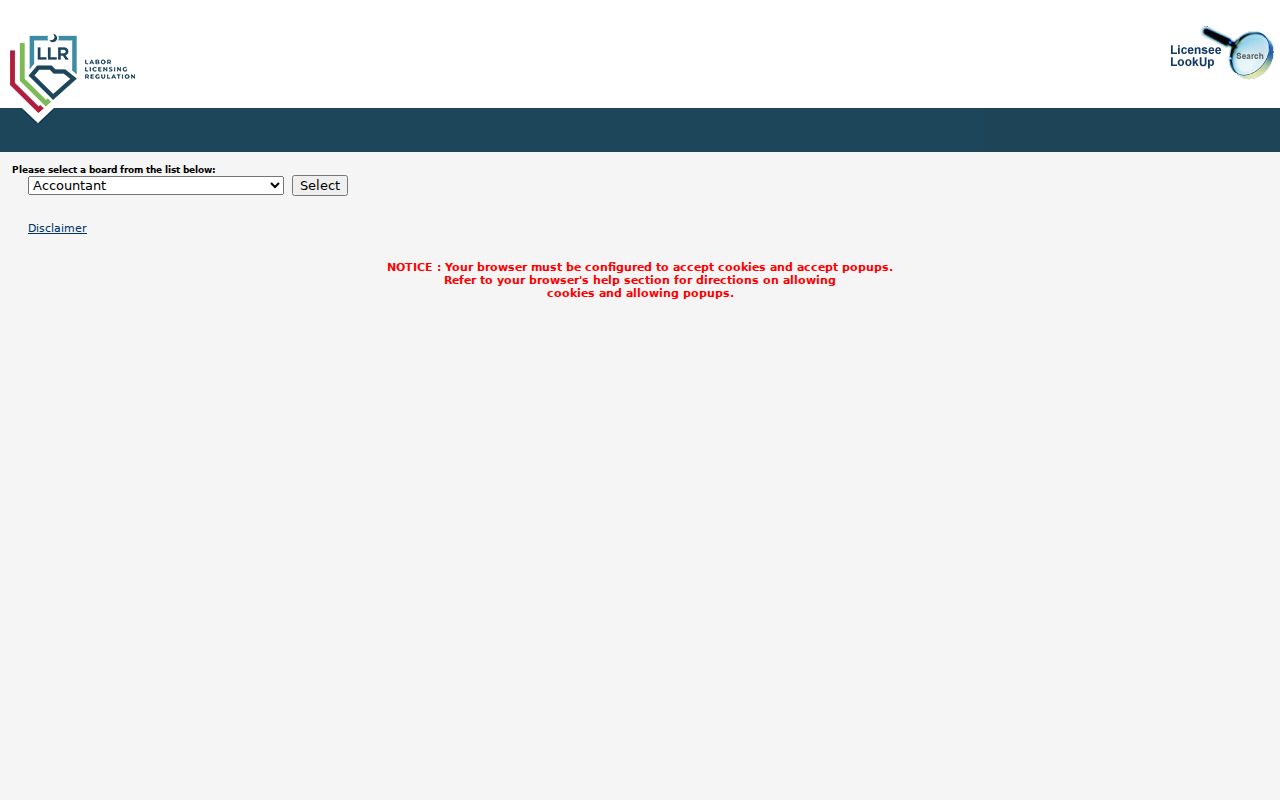
Use a credential number or exact licensee name, and read the displayed classification and status in its own context.
Simpsonville Resident Record Boundaries
Some fields are absent by design. South Carolina FOIA exemptions, vital-record confidentiality, sealed court matters, driver-data protections, voter restrictions, and the Address Confidentiality Program limit access. The ROD and Clerk permit written requests to redact specified sensitive numbers from internet-posted official-record images. That process addresses listed identifiers in a web image. It does not erase the underlying deed or turn every record private.
Lawful personal use. Simpsonville records can support family history, estate research, civic questions, and source verification. Do not use information from any record to stalk, harass, threaten, or harm another person.
ACP participants may use a substitute address with government agencies and courts. Starting January 1, 2026, covered present or former judges and certified law-enforcement officers have a state process to seek removal of certain address and tax-map information from public government websites. A blank, substitute, or older field is not a reason to fill in a missing fact from speculation.
Checking Simpsonville Name Matches
Names repeat. Start with a full legal name and an approximate period, then test one independent fact. On a land trail, compare the property card’s map number and legal description with a deed’s date and instrument reference. For a court record, retain the case number, party type, filing date, and status. For a marriage or probate lead, keep the year and custodian record number. A historical directory needs its title, publication year, page, and the abbreviation key used in that volume.
When an online trail stops, use the proper fallback: a focused City request for a municipal document, the Clerk for an older file, the ROD historic index for an early instrument, the South Carolina Room for a directory or map, and DPH or the adoption registry for restricted family records. This record-by-record approach is slower, but it avoids merging unrelated Simpsonville people simply because their names match.